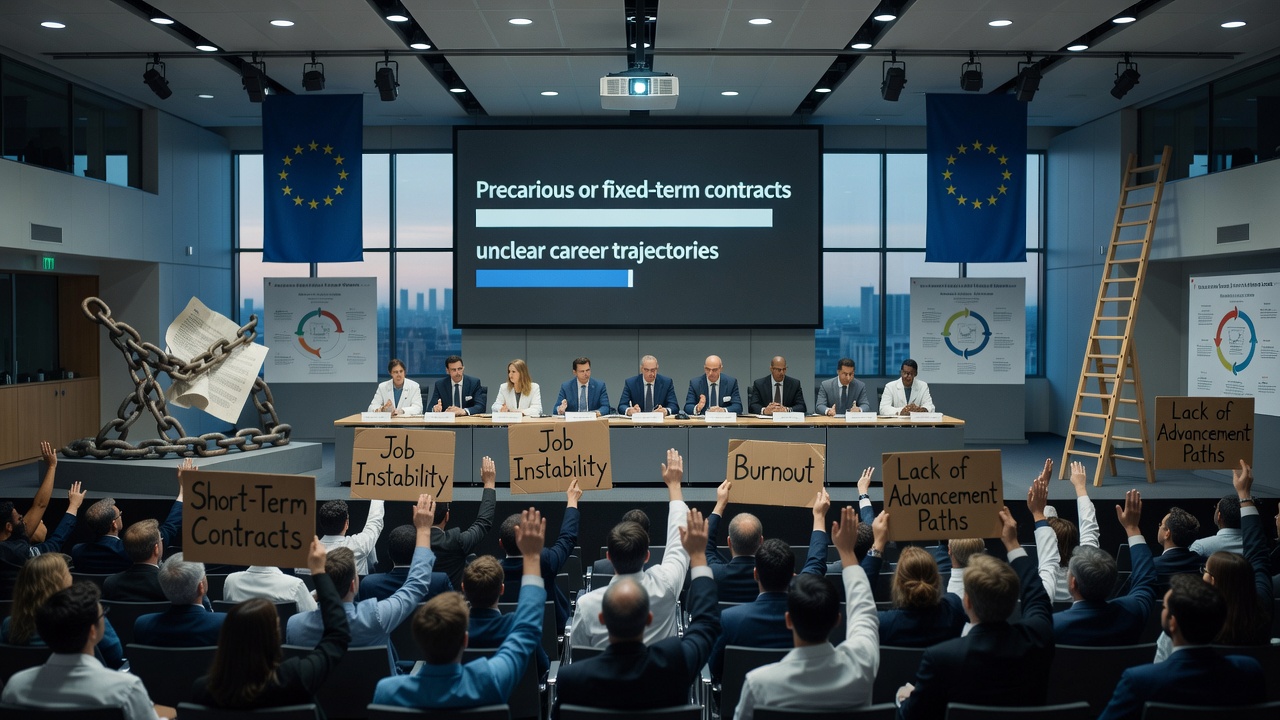
At the European Commission's Research and Innovation Days conference, held November 10-11 in Brussels, attendees identified short-term and insecure employment contracts as the single biggest barrier to making scientific careers attractive. A related concern-the absence of clear advancement paths-ranked second in an audience poll conducted during a panel session on the topic.
What the Poll Revealed
Organizers of the panel discussion asked conference participants to rank obstacles facing researchers across Europe. Precarious or fixed-term contracts emerged as the dominant answer by a wide margin, signaling that job instability remains the central grievance among scientists and early-career researchers working within the European Union's research ecosystem. The second-most selected issue, unclear career trajectories, suggests that even researchers who secure positions often lack visibility into how to progress professionally over time.
Why This Matters for the Research Workforce
Short-term contracts are a long-documented feature of academic and scientific employment in many European countries, where postdoctoral researchers and early-career scientists frequently cycle through multiple temporary positions before-if ever-securing permanent roles. This pattern can discourage talented individuals from entering or remaining in research, contribute to burnout, and push skilled workers toward industry or outside Europe entirely. Speakers at the conference reportedly urged the European Commission and member states to pursue comprehensive solutions rather than incremental fixes, though specific policy proposals were not detailed in available reporting.
Limits of What Is Known
The available information describes an informal conference poll and general calls for reform rather than a formal study, survey methodology, or new regulatory proposal. It is not yet clear what concrete measures, if any, the European Commission intends to pursue following this discussion, or on what timeline. Readers should treat the poll results as indicative of sentiment among conference attendees rather than a statistically representative measure of the broader European research workforce.
Context for US Readers
The structure of European research careers differs from the United States in some respects, but the underlying tension-balancing flexible, grant-funded staffing with the need for stable career paths-mirrors debates within American universities and federal research agencies, where postdoctoral and adjunct positions have drawn similar scrutiny in recent years.